Research Program
My research focuses on using astrophysical and cosmological observations to understand the fundamental nature of dark matter. Dark matter makes up roughly 25% of the universe, yet we know very little about its composition. My research program touches on several different experimental techniques to understand the fundamental nature of dark matter. Cosmic Probes extract information about the fundamental interactions of dark matter from its distribution and clustering. Indirect Detection is sensitive to the Standard Model particles that could be produced through the annihilation or decay of dark matter in regions of high density. Direct Detection attempts to detect very rare interactions between dark matter and Standard Model particles in low-noise detectors on Earth.
To better understand the nature of dark matter, I am heavily involved in the development, operation, and analysis of large cosmic survey experiments. Specifically, I work on several ground-based optical/near-infrared imaging surveys. I am the Principal Investigator of the DECam Local Volume Exploration Survey (DELVE), a member and builder of the Dark Energy Survey (DES), and a member of the LSST Dark Energy Science Collaboration (DESC), a scientific collaboration associated with the next-generation Rubin Observatory Legacy Survey of Space and Time (LSST). I am also an affiliated member of the Fermi Large Area Telescope (Fermi-LAT), a space-based gamma-ray telescope. I also work in the lab to develop ultra-low-noise CCD detectors for future cosmic survey experiments.
Cosmic surveys provide an enormous amount of data and there are many opportunities for student research at all levels. If you are interested in studying dark matter or near-field cosmology, please contact me.
DECam Local Volume Survey (DELVE)
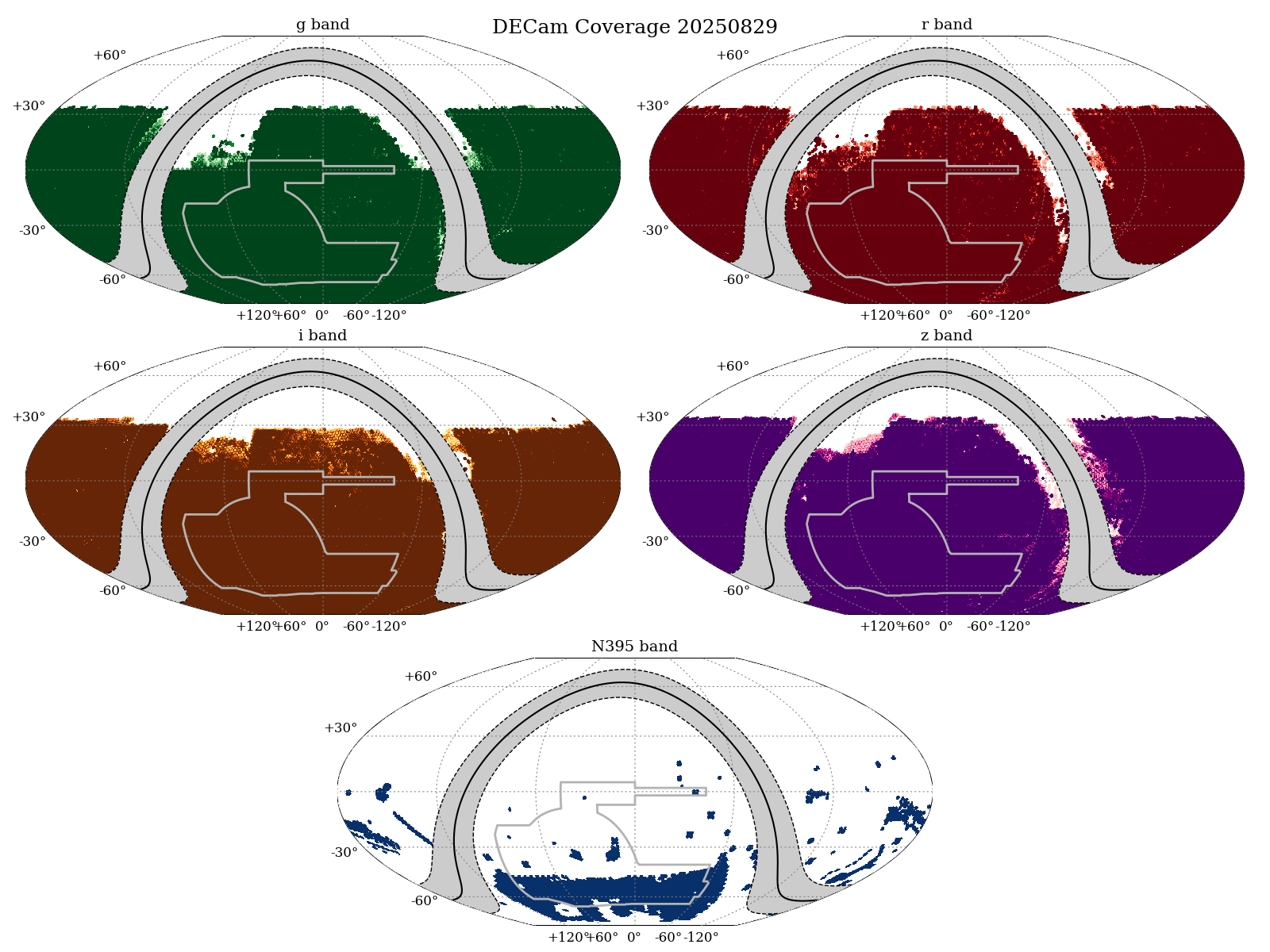
I am PI of the the DECam Local Volume Exploration Survey (DELVE), which combines more than 150 nights of DECam observations with archival data to enable studies of near- and far-field cosmology. DELVE provides contiguous DECam imaging of the southern extragalactic sky, covering >20,000 deg2 to a depth of g,r,i,z ~ 24 mag. The DELVE data have been used to expand our understanding of ultra-faint dwarf galaxies in a wide range of environments and study the growth of structure in our universe using weak gravitational lensing.
More information about DELVE can be found at https://delve-survey.github.io. Public releases of the DELVE data are hosted by the NOIRLab Astro Data Lab: https://datalab.noirlab.edu/delve.
Selected Publications:
- Anabajagane et al. submitted (2025) [2509.03582]
- Anabajagane et al. OJAp 8 (2025) [2502.17674]
- Tan et al. ApJ 979, 176 (2025) [2408.00865]
- Drlica-Wagner et al. ApJS 261, 38 (2022) [2203.16565]
- Drlica-Wagner et al. ApJS 256, 2 (2021) [2103.07476]
Studying the Faintest Galaxies
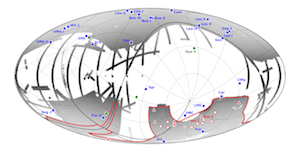
Our Milky Way is surrounded by many small satellite galaxies. These galaxies are the most ancient, least chemically enriched, and most dark-matter-dominated systems known. The characteristics of these "ultra-faint" galaxies are sensitive to the properties of dark matter and the processes that drive galaxy formation. The known population of ultra-faint satellite galaxies has increased dramatically with the advent of large digital sky surveys; however, we are still far from complete. My group works to find, study, and model ultra-faint galaxies around our Milky Way and other nearby galaxies. We are heavily involved in the collection, reduction, and validation of large survey data sets.
If you'd like to learn more about the search for dwarf galaxies, you can check out articles here and here in Symmetry Magazine.
Selected Publications:
- Tan et al. submitted (2025) [2509.12313]
- Cerny et al. ApJ 953, 1 (2023) [2209.12422]
- Mau et al. ApJ 932, 128 (2022) [2201.11740]
- Nadler, Drlica-Wagner et al. PRL 126, 091101 (2021) [2008.00022]
- Nadler, Wechsler et al. ApJ 893, 48 (2020) [1912.03303]
- Drlica-Wagner, Bechtol et al. ApJ 893, 1 (2020) [1912.03302]
- Mau, Drlica-Wagner et al. ApJ 875, 154 (2019) [1812.06318]
- Drlica-Wagner et al. ApJL, 833, 5 (2016) [1609.02148]
- Drlica-Wagner, Bechtol et al., ApJ, 813, 109 (2015) [1508.03622]
- Bechtol, Drlica-Wagner et al., ApJ, 807, 50 (2015) [1503.02584]
Stellar Streams Around the Milky Way
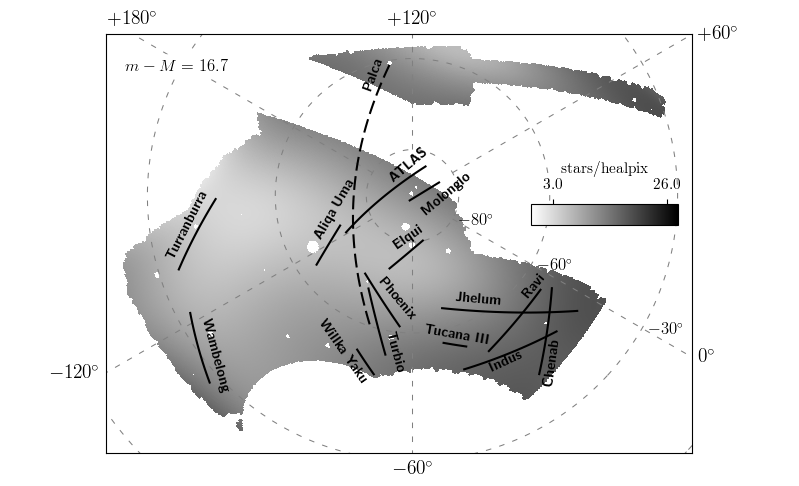
Stellar streams are created when satellite galaxies and star clusters are disrupted by the gravitational potential field of the Milky Way. These streams of stars provide a direct measurement of the local gravitational acceleration near the stream. As such, stellar streams can be used to constrain the size and shape of the Milky Way's dark matter halo. In addition, one key prediction of the cold, collisionless dark matter paradigm is that dark matter should clump on scales much smaller than the smallest known galaxies. These dark matter "subhalos" could be detected through their gravitational influence on stellar streams. We have searched for new stellar streams using the wide area, precisely calibrated data from the Dark Energy Survey (DES). Using the first three years of DES data, we have discovered nearly a dozen new stellar streams. These discoveries increase the known population of stellar streams by ~50%.
The DES stellar stream discoveries accompanied the first public release of the DES data. I am heavily involved in the production, validation, and distribution of high-level DES data products as the founder and "coordinator emeritus" of the DES Science Release working group.
Selected Publications:
- Ferguson et al. AJ 163, 18 (2022) [2104.11755]
- Tavangar, et al. ApJ 925, 118 (2022) [2110.03703]
- Shipp, et al. AJ 160, 244 (2020) [2006.12501]
- Shipp, et al. ApJ 885, 3 (2019) [1907.09488]
- Li et al. MNRAS 490, 3508 (2019) [1907.09481]
- Shipp, Drlica-Wagner, Balbinot, et al. ApJ 862, 114 (2018) [1801.03097]
Ultra-Low Noise Skipper CCDs
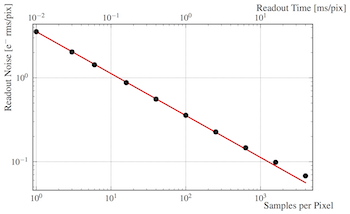
Silicon charge-coupled devices (CCDs) have ubiquitous use in astronomy and cosmology. CCDs convert photons into electrons/hole pairs via the photoelectric effect, which can then be digitized to yield precise measurements of astrophysical objects. CCDs are also extremely sensitive particle detectors that can be used to search for dark matter and other rare events. State-of-the-art scientific CCDs have a root-mean-squared (rms) electronic readout noise of ~3 electrons per pixel. This noise sets a technical limit on the sensitivity of CCDs both for very faint astronomical sources and very rare particle searches. At Fermilab, we have developed a "Skipper" CCD readout structure to overcome the conventional limit on readout noise. Skipper CCDs are able to non-destructively read the charge in a single pixel multiple times. This allows us to reduce the readout noise by the square root of the number of reads. My group works to adapt the Skipper CCD technology and its derivatives to future astronomical observations. If you are interested in reading more about these efforts, check out this article in Symmetry Magazine.
Selected Publications:
- Marrufo Villalpando et al. Proc. SPIE 13103, 131030F (2024) [2406.10756]
- Marrufo Villalpando et al. PASP 136 045001 (2024) [2311.00813]
- Botti et al. IEEE T-ED, 71, 6 (2024) [2308.09822]
- Marrufo Villalpando et al. Proc. SPIE 12191, 121910U (2022) [2210.03665]
- Drlica-Wagner et al. Proc. SPIE 11454, 114541A (2020) [2103.07527]
- Tiffenberg et al., PRL 119, 131802 (2017) [1706.00028]
Searching for Dark Matter Annihilation with the Fermi-LAT
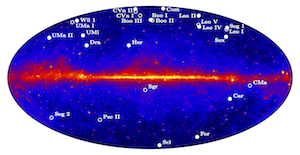
If dark matter is made up of a massive particle, it could decay or pair annihilate to produce energetic standard model particles. One way to detect such a signal is through gamma-ray photons using the Fermi Large Area Telescope (LAT). I have been specifically interested in gamma-ray observations of nearby clumps of dark matter, such as the dwarf satellite galaxies of the Milky Way. Dwarf galaxies are rich in dark matter but lack astrophysical gamma-ray production, making them prime candidates for dark matter detection. Detecting a glow of gamma rays associated with dwarf galaxies would be an exciting clue about the nature of dark matter.
As a graduate student, I enjoyed working on the event reconstruction software to improve the performance of the Fermi-LAT instrument. I implemented low-level hardware triggers and machine learning algorithms into an improved gamma-ray event selection (called "Pass 8"). Much of this work bridged the fields of particle physics and astrophysics.
Selected Publications:
- Circiello et al. ApJL 978, 43 (2025) [2404.01181]
- McDaniel et al. PRD 109, 063024 (2024) [2311.04982]
- Fermi-LAT Collaboration ApJ 834, 2 (2017) [1611.03184]
- Drlica-Wagner, Albert, Bechtol, et al. ApJL 809, 4 (2015) [1503.02632]
- Fermi-LAT Collaboration PRL 115, 231301 (2015) [1503.02641]
- Fermi-LAT Collaboration PRD 89, 042001 (2014) [1310.0828]